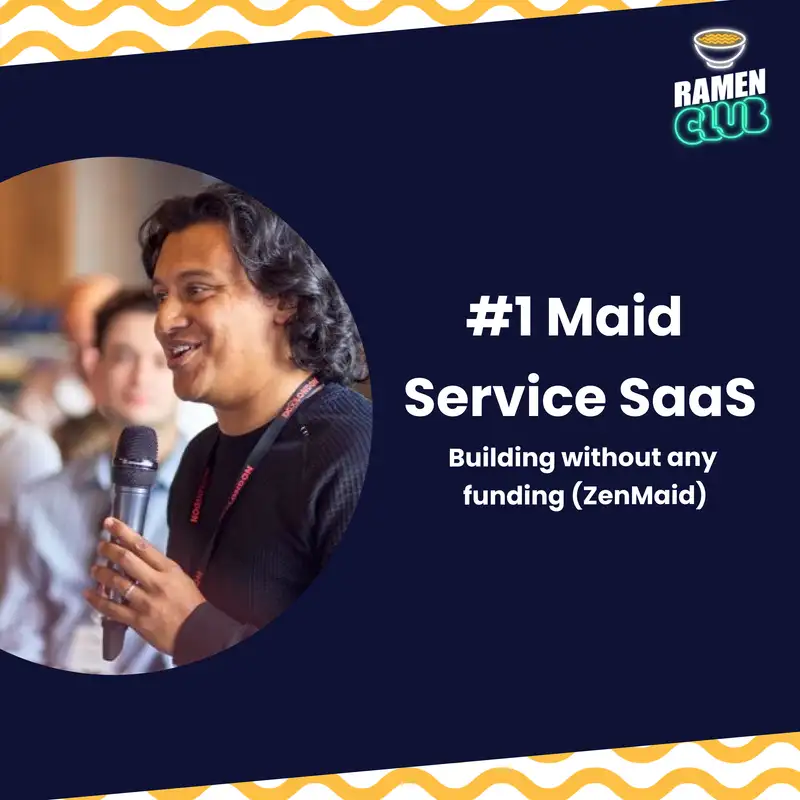
Bootstrapping the #1 Maid Service SaaS: Amar Ghose (ZenMaid)
Welcome back to the Ramen Club Podcast, the show where we interview ramen profitable founders from the Ramen Club community and how they discovered, built, and grew their products to ramen profitability and beyond. My guest today is a friend, a longtime member, Amar Ghosh. He is the cofounder of ZenMade, a large SaaS to help maid service business owners manage scheduling, bookings, and much more. We actually interviewed Amar a few years ago. Some of you may remember this, and I'm excited to catch up with him and how things are going today, future plans, and his advice of people starting or running their own SaaS.
Charlie:So, Amar, how are you doing?
Amar:Doing great.
Charlie:Good stuff. Just to get us started, for those who don't really know, what is a maid service business?
Amar:So it's essentially like a home cleaning business, a domestic cleaner here in in The UK. Yeah. Anyone that you would hire to come in and to clean like your home, like specifically as a service. We do serve a lot of Airbnb cleaners, which is a very, very similar service, but the scheduling challenges are actually like quite different. But yeah, any individual or company that comes in and cleans someone's home.
Charlie:And you started Zemade about thirteen years ago. Is that right?
Amar:Yes. That's correct.
Charlie:So you're comparatively, I would say, a veteran compared to some of to some of the other wonderful people we've had on this pod. To help share a bit of context for those listening and less familiar with you and Zeme, can you talk a little about what phase the company is now in terms of what you can share in terms of like ARR, headcount, customers, that kind of thing?
Amar:Yeah. We started the year at, I think, around 2 and a half million dollars, and we've jumped up quite a bit during the year. Not quite like quite double, but like pretty pretty close to that. Headcount's around 30. And so we did like we did a team retreat in Barcelona this year that was, what, 22, 23 people.
Amar:Yeah. Mean, it's a it's a real company these days, which is a bit a bit surreal.
Charlie:For sure. And I wanna get into this in a bit more detail a little later, but I wanna go back, like, fifteen years to the early twenty tens in California. So I know you had a few different projects, side hustles, whatever you wanna call them back then. But eventually, after going to Reddit thread, you discovered the idea of creating your own made service business. So you before you actually ran a SaaS for made services, you actually ran your own made service business called, I believe, Fast Friend Spotless?
Charlie:Fast Friendly Spotless. Yeah. Fast Friendly Spotless. I love I love to just hear, like, kind of that just learn about that kind of time for you, what that was like, and how that led into creating a SaaS for it.
Amar:Yeah. Definitely. So I I think that the really important thing about that is just, like, the idea of kind of, like, skill stacking and why, like, every experience that, you know, like viewers, you know, will go through, whether your project works or not, you're always going to walk away with like a new set of kind of skills and everything. And so the maid service that I ran in Southern California was the first time that I was like really trying to like have like an actual kind of company. And it forced me to grow up in many ways, which is quite funny in hindsight given like where I was when I started Zen Maid.
Amar:But it was a really, really important experience in my life. I don't think that running a maid service was as directly valuable to solving the actual future clients' problems as maybe we initially thought. Because the way that I ran the maid service, like first of all, like, you know, to be completely transparent, it wasn't a very successful maid service. There's a reason we don't run a maid service anymore and we now like run a SaaS. I've got lots of friends in the industry that started at the same time and were very, very successful.
Amar:For us, it wasn't massively successful. But being able to say that I was a maid service owner or just that I had at least tried, that was really a good foot in the door with people that we were talking to initially. And it gave me a sense of confidence. And I think that's actually what more translated into our success with ZenMaid than even the direct, like, experience. It was more like what came because of the direct experience.
Charlie:Like the trust that they had, that you understood them and could build something that would help them.
Amar:Yeah. And I think the way that I showed up on the calls, because I had a false sense of, like, of, like, confidence in, like, in, like, you know, how we had solved things and everything. And I think I was very quickly humbled by user feedback and realized how wrong I was about a lot of my, like, initial assumptions and stuff like that. But, you know, it all worked out for the best. I'm not complaining.
Charlie:Something I think about a lot now is founder market fit. How if everything is equal with you and someone else, if one person actually has a bit more connections or knowledge or experience in a certain sector, you have an advantage. It sounds from what you're saying. It helps. It's not enough, but it does help.
Amar:Yeah. Exactly. It it it definitely helps. Like, I think that every successful business is going to take a ton of hard work, but you can apply that same amount of hard work to places that you have an advantage. One thing though is I think that a lot of people might hear that and think almost like direct competition, and I just think that it's possible for lots of companies to win in multiple like industries that I'm sure that there's like folks that you're like somewhat competing with directly, whether it's for cozy or for like Ramen Club, where it's like there's more than enough going around where you can be very happy with your outcome and so can three or four other, like, competitors and everything.
Amar:Right? And so, you know, you you just want to apply your hard work to the place where it gives you the best opportunity of succeeding.
Charlie:So am I right in saying when you started ZenMade, you weren't the first SaaS that was helping these people? Like, there was it was already pre validated in a way?
Amar:Yes. Correct. There were a couple of Made specific software that were out there. Made Easy Software and Made Books were the primary two that were already, like, specific to our niche. And then there were twenty, thirty, 40 softwares that were out there that were for more general service businesses.
Amar:So, yes, we weren't reinventing the wheel or anything like that. It was a very well validated idea even even at that point.
Charlie:A comment I often see online in kind of indie hacker Twitter and elsewhere is people will have an idea, but then they see it already exists or there's, like, competitors, and they get disheartened, and then they start again. And I just think it's kind of the wrong way to think about this. Markets that have a few competitors are usually big enough to have multiple players like like the one that you're in. And I think it's a bit of a mindset shift that a lot of new people sort of need. Is that something you've seen?
Amar:Yeah. Definitely. I I think that it should be not necessarily a immediate red flag, but there's something that should require strong consideration that if no one else is out there doing what you're trying to do of just asking why. And there may be a reasonable explanation for that because you're applying, you know, a a new technology, a new AI in a way that people just haven't been able to, like, to to do yet. But if it's, you know, some, like, established idea, there's a good chance that other people have tried to do it, and there's a reason that, like, it may or may not, like, exist.
Amar:So, like, yeah, it's not necessarily a no go, but it's it's something that should be taken into account quite strongly when, like, deciding on whether to move forward with an idea.
Charlie:I think sometimes people also jump to mom testing it too quickly. And actually, sometimes you can just be really early on a trend. Like, I think Rami with hover code, he was just really early on people searching for QR code generators for businesses and stuff like that. And I don't think there's a lot of competition, but there was still search volume that this was like a growing kind of market. I think if you can't find any competitors or any kind of search traffic or that sort of thing, a lot of the time it's maybe something that's not gonna work so well.
Charlie:That's kind of my impression.
Amar:Yeah. I mean, I think generally that's one of those advantages that you're gonna want to be looking for before moving forward with something is, you know, advantages can be skill wise, but it can also be just like recognizing an opportunity and having the right skill set to jump on that.
Charlie:When you just got started and you could see these other competitors, was there any particular way? And, you know, there might be some twenty twenty hindsight now, but was there anything that you thought, oh, we're gonna kind of try and focus on this particular type of market or or feature or something like that?
Amar:If someone's like just starting out, like the most important thing is really to just like really get started and to get the product out there or to get something out there so that you're getting like actual feedback. So essentially when we launched Zen Made, we launched with a booking form and a very simple like calendar. And then we used Twilio and I think Postmark or some other email provider at the time to add on like little text and email reminders onto like the calendar. And we worked for six months or something to like define that and get that out. And I'm pre selling people during that time.
Amar:And we thought that this booking form that we had designed was going to be like the greatest thing since sliced bread. The calendar part was almost like, oh, like no one will sign up if we don't have like at least something basic here that just like does like the trick there. But we have to start somewhere. Right. So we were going almost like lean startup.
Amar:And so that was like the big kind of idea. We launched and nobody cared about the booking forms. Like honestly, we didn't do a great job like executing, but what we thought was a basic calendar, people were blown away by just a simple calendar that had cleaning specific messaging already built into it to go out automatically. And that's something that we could have designed for months and months and months and we wouldn't have actually known that. And so like that's one of multiple pivots that we knew that we wanted to serve housecleaning businesses and maid services.
Amar:We knew that from like the very first moment that we started coding, but the actual value that we bring to maid services, that has been like a real maze for us to navigate. Like nothing has really looked the way that we kind of expected it to when started it. And in hindsight, it's naive of me to think that back then that I could have like, you know, seen the future in that way. Right? So it's almost like by design that it happened that way.
Charlie:You've always been a big proponent of talking to your customers a lot of user research. In the early days, what was that feedback loop like? Was that related to sales? Did you just have it streaming through on customer support chat? Was it just quite organic?
Charlie:Or did you have a kind of a plan of how to kind of gather these findings from people?
Amar:Honestly, I'm just a little bit more like extroverted and saw that really as like the main way that I was bringing value to the business. So I was just always looking for opportunities that like, you know, if someone was willing to jump on a Zoom call with me and screen share so that I could help to, like, debug an issue that they were having or whatever, I would prefer that than to actually solve it by email because getting them on the call meant that I could have a conversation. I can get to know them. I can figure out other ways that we can help them, and then I can also find out more about how they're using the software. So I was quite intentional about it, but wasn't really all that systematized in terms of you know, it wasn't consistent.
Amar:Didn't it didn't like, you know, sometimes it was that, sometimes it was just, like, texting people, like, directly. But I just tried to be as, like, human and available, like, as possible in a way that I knew that our competitors weren't being.
Charlie:And in those early days, let's say for your first 50 to a 100 customers, what did marketing and sales look like for you? Was it quite cold outreach focused at that time?
Amar:Yeah. First 100 customers was all a cold email and cold calling. In a previous life, I did sales in, like, in tech startups. That's what I did before, like, starting Zen Made and then running that Made service was a side project to that. So that was really just leaning into my, like, core skill set where, you know, yeah, essentially I had a virtual assistant that would send out, I think, about 50 cold emails a day to mage service owners that she'd just pull, like, off of Yelp.
Amar:And then in the mornings before I went up to work in San Francisco, and then most of the day on Saturdays, I would just pick up the phone and just call people that she had already emailed. And whoever answered the phone, I'd be like, oh, I emailed, like, the owner, you know, did did they get it? And just, like, you know, use that to try to get my foot in the door. And that got us from zero to about about a 100.
Charlie:And something I love is also just how it's evolved so much over the years. From cold outreach, which which works, can be fairly simple. And now you have, like, the MAID Summit. So one of the biggest kind of events, conferences for maid service businesses. You got Zen Made Mastermind, the Facebook group.
Charlie:So, actually, community is quite a big part of how your business operates and how you do marketing now. I'd love to hear a bit more just, like, how it kind of evolved to that point where you see saw community as quite a big part of it, that kind of works for you.
Amar:So I'm I'm nontechnical. And at the beginning when we first started, cofounder was really the one who was doing and owning the product, even though I was the one who had more like the industry expertise. So I could direct him on maybe what we were going to build next, but then I wasn't very involved with the actual design of that. And so the end result of that was that I would essentially talk to him and then he might go off for a couple of weeks and be like building something and then come back with something to show. And in that sense, it wasn't as iterative as I like would have liked.
Amar:But what happened was I had a lot of time where I essentially was like, you know, asking myself, how can I add value to the industry, like, without it being like through the product? So it was almost like I had too much time on my hands, and this was just one of the ways that I was trying to fill my time to kind of positively like impact our business. And so the mastermind, it's funny, that was actually I tried to launch a paid community. That was in 2015, so we had about a thousand people on our email list. And I wrote out like a whole, like Jeff Walker launch style, like five email sequence and then, you know, six emails on the day of like, you know, closing and, you know, the Internet marketing stuff and like all that.
Amar:And I spent a bunch of time working on this campaign and I launched a paid community for Zen Made to bring like, you know, owners that were serious about growing their business together and a thousand people on our list. And we got three people to sign up. And one of them was like he'd, like, become a pretty close friend of mine. And I think he just kind of signed up, like, to support us, but wasn't, like, actually, like, interested. And it it was it was pretty devastating.
Amar:I'm not gonna lie. So, like, I think we took it seriously for, I don't know, forty days or something like that and then just refunded everyone's money and and just signed it, kind of like put that idea to the side. But we had tried to do that in a Facebook group. And so we just left the Facebook group with those three people and then over time just began like asking people if they wanted to join this Facebook group. And we would just do that on calls when we talk to people in person.
Amar:Anytime that they would contact support or ask us any question that didn't really have to do with the software of like, hey, where would you guys recommend hiring cleaners or whatever? We just started pointing them to the Zen Made Mastermind. And then over time, that just grew like quite organically. At some point, I think around 100 members, we had someone that kind of recognized that she could get business by helping people in the group. And she just came in and just like single handedly drove enough engagement in there to get us to maybe like two fifty or something.
Amar:And then, yeah, it just kept growing from there, and now it's 10,000 made service owners.
Charlie:Wow. I didn't realize it was that large. Just to clarify something, is it just for your customers, or is it kind of anyone with a made service company?
Amar:So we have two groups. The Zen Made Mastermind is 10,000 and that's for anyone in the industry. And then we have the Zen Made Inner Circle that has about 3,000 people and that's for like trial users and current users. Wow. With these kind
Charlie:of things, like, one of the biggest issues people have when they try and build communities for customers is they sometimes struggle to prove the value in it, which matter sometimes intuitively you might know, but it's hard to prove it to, like, if you have a boss or something. Is it quite clear for you, like, the value that it's providing? Are there metrics you track, or is it kind of just so obvious that it's not needed?
Amar:So, like, my my team tracks a lot of the numbers, but I feel like I operate a lot more intuitively. Like, I I like looking at the data and stuff, but to me, I feel like we're at that level now where I'm genuinely more doing things to I don't want to say bring the industry together. That's almost quite cliche, but we're looking for gaps in the industry where it's like we are uniquely set to kind of like solve them. And so we have the biggest marketing machine in the industry when it comes to like home cleaners specifically. So having a way for those folks to connect and then to find like coaches and consultants and stuff, it just like makes sense to me where like I don't need to see any numbers from that to know that just running that group and having our name associated with that group is going to both pay off for us in the long run.
Amar:You know, even if we lost a little bit of money on that, that just seems like a cool thing for us to, like, do. So it's almost like I don't even care if it's entirely, like, profitable as long as it's not, like, really burning a hole, like, in in in our pockets. Right? And so so in in in that sense, like, I'm not always looking at the ROI of a lot of things.
Charlie:You think a lot about brands then and building trust. Right? You wanna thinking about how you can add free value for customers and the industry and in the long run, it kind of comes back to you?
Amar:Yeah. Exactly. Exactly. And and I think, I mean, you know, you you said at the start, you mentioned that I've been doing this for thirteen years. And, like, I've been set on doing this for quite some time that I realized quite early on that having another chance at having a working software with like an established niche and just opportunity that we had here at Zen Made, that that's not something that comes around every day.
Amar:And especially for me being a nontechnical like founder and having, you know, my initial co founder left in 2017, right? And so for me, like I just realized that this was like my best chance to kind of, like, wealth and just, like, held on for the long run. But I'm very much a believer that when I zoom out five and ten years, it makes perfect sense to give up a little bit of money on on the front end or to do things that just help the industry. And, yeah, to expect those things to to come back to us and to be perfectly fine if, like, if they don't. You know?
Amar:Like, that's the whole thing is I'm not gonna be, you know, shaking my fist at, like, at the sky or anything if we we do some things and we add some value to people and, you know, we don't quite get compensated as well as like we'd like. I already feel just like the money that we currently make is already surreal to me that, like, you know, it blows my mind compensated the way that we are to just help this little niche. You know? Like, I don't know. I like that.
Charlie:So in doing this thirteen years, after a couple of years, you moved to Thailand when you were paying yourself about a thousand bucks a month. So that was your kind of ramen profitable era. So it it's hard to kind of summarize thirteen years, obviously. But in terms of, like, how you kind of spent your time, how has that sort of evolved over the years? Like, it probably in many ways, but just like if there's just, like, three big kind of chunks of different times where, like, early days, you're just spending all day doing cold outreach, talking to users, sharing feedback, that kind of thing.
Charlie:How has that evolved?
Amar:I mean, first, like, probably five years really was really just like in it doing the work every day, you know, and what that work was changed over over time, right? That, you know, a couple of years in I was more working on like our email marketing funnels, whereas at the beginning I was spending a lot more time doing like outbound email and generating leads that way. At some point, SEO began to kick in and the community stuff began to kick in. And so like how I spent that time changed. But I would say the first five, I mean, I mean, even even like seven or like or eight years, really, it was really just like me in there really like doing a ton of the work.
Amar:And then, of course, I always had support on the product side doing the product, which I feel like it's kind of funny to talk about like a SaaS company that where I'm like, oh, I was doing all of the work except for the product. But, you know, the whole thing is like that's why we have the company that we do today because we were able to focus on both sides like at once. So after like seven or eight years, that was where, like, at some point around maybe year four, we began to add people to the team, but that was still very much like me sort of working directly with everybody. And it was still very much me and everyone there was almost like an extension of me other than like the product team. Whereas around seven or eight years in was where the team really began to take over and to be able to just run with things kind of on their own, like a little bit more and stuff.
Amar:And so it's essentially at the beginning, it's like I was building the product and building the marketing and making all of those decisions. Then from there, it began to be like building the actual company of putting more of the process and the systems in place and getting everything repeatable and all of that stuff. And then, like, now I'm in that phase of building the team that builds the actual, like, company.
Charlie:Right. I see. So kind of early days hustling, doing everything. Then you there's, like, a halfway point where there's a team, but you're, like, heavily integrated in the team and still managing them and still working on the business. And now you're kind of working on the business less so in the business, if that makes sense, just kind of overseeing things.
Amar:Yeah. Definitely. It's one of those things where the business runs entirely like without me day to day, but I'm still very heavily involved day to day. It's just a lot more strategy and thinking like way, way ahead. But I could step away for probably months at a time now and come back to to a stronger business.
Amar:But, you know, we're we're thinking about things like solving different problems in the industry and potentially acquiring different companies that are better out there and stuff. And that that's the kind of thing that probably isn't going to come from my team. That's got to come from, like, from the founder, at least at least at the size that we're
Charlie:at now. Do those three phases, do they relate to the kind of tipping points where everything kind of breaks because it's at a new scale and you have to just work differently and have different systems? Like, for example, when you start getting a team, you have to have a bunch of different stuff. Or when you get a certain customer base, you have so much customer support that you cannot do it yourself. You have to outsource it.
Charlie:Were those related or are those slightly different in terms of, like, the point where it started to completely break? You have to rethink stuff.
Amar:It's a combination of both, but I think that everyone has their own risk tolerance. I think that everyone can choose to go at whatever pace they want. So for me, I very purposely took considerably less money than I could have out of the business so that I could pay people earlier to do more of the work. I've always been happy to give up a large portion of my margin and to live on considerably less so that, yeah, essentially like more things are getting done without me having to worry about them day to day. And that's, you know, like my kind of life philosophy is like, I love getting things done, but I hate doing things.
Amar:And so everything that you see in Zen Made is just me trying to, you know, accomplish more while doing less. Right? And so that's like as much as I can like do that, I'm happy to like reinvest there. You do have other people that will try to do everything themselves until they can't anymore and then will hire at that point. For me, I feel like at least the way that I choose to sort of focus like my mental energy and stuff, that if it got to that point for me, that would be a failure on my part because I should have hired much, like, much sooner.
Amar:Right? As as I try to hire ahead of that stress and to lead, you know, a low stress life.
Charlie:What's your approach to finding the right talent for Zen Made?
Amar:I think that right right now, at least, it's very much like an employer's market and that I think that you can have very, very high standards for what, like, you're you're looking for. Yeah. I mean, I I I think I think really what what the Zen Made strategy comes down to that I think has changed a lot for us over the past couple of years is I think like a lot of companies, we started out hiring by trying to write an ad and by trying to attract as many qualified applicants as possible. And now we write ads to try to attract the one and only person that's perfect for us. Right?
Amar:And we try to get that specific about things where it's no longer like, Oh, we're trying to get 30 qualified applicants for like our head of marketing. It's we're thinking about, okay, what's going to make one person stand out above everyone else? And how do we try to filter for that to get it down to the three people that we think could be that person and then to go for that. And honestly, I think that you can apply for that mindset to any level. The other thing that I was telling Tom at Ramen Space is like hire people who care.
Amar:You can find people that just care way more no matter what you're planning on paying them, whether it's $5 an hour for a VA, whether it's $50 an hour for like a dev or like any level, you can find people that just care more. And I think we've done a really good job of just finding those people, and so they grow massively within our organization. You know, we we just have so many stories of, like, really talented team members that are now three levels above where they were when they started with ZenMade, and it's because of that approach.
Charlie:I love that. So it sounds like being more specific in, you know, the top of the funnel is helping. But if you don't do that these days, especially with all the tools where people can mass apply to, like, hundreds of different jobs and applications at once. Do you would you just otherwise be completely inundated with applications from people?
Amar:Yeah. Dev definitely. And I I can give an example here of, like, how specific we go for for the the most recent hire that we made at Zen Made was, like, I just hired an executive assistant, and our job title was, We're looking for an AI powered EA to an ADHD CEO. Yeah, so we were like insanely like specific about, you know, just like what we're looking for, the tools, I mean, essentially just AI in general, and like that's almost like a mindset that we need them to bring. And then like, you know, we had a video that accompanied that job ad with me talking on there, you know, and I say pretty much straight off of like, Hey, like this video is to help like let you know whether this position might be right for you.
Amar:So I'm going to like share a bunch of things. But like to start, if the sound of my voice is grating to you, if you've had a bad experience with folks with a California accent, or I say like too much and that's going to drive you up a wall, don't apply because you will be talking to me, right? And so it's like one of those things where we take a little bit of a different approach where I'm trying to get down to the, you know, here are the five people that, you know, have a husband who has ADHD or grew up with an older brother that has ADHD. And they're, like, reading my post and going, oh, perfect. I know exactly how, like, brains like a Mars work.
Amar:And in the past, we'd try to hide it. We'd try to work with, like, you know, more traditional folks, and that always ended up backfiring on us.
Charlie:I'd love to hear more about what your executive assistant does for you and the impact she's had on you.
Amar:I mean, there's a lot of things that she's helping me with, but one of the primary things is she's helping me to really get a lot of my thoughts kind of out and structured for other team members for us to discuss and to kind of strategize on. And so it's a lot of using AI and then of bringing that down or fighting with the AI to get the output that we want and then editing it and essentially being like the human like approval stamp for a bunch of AI stuff where like, you know, I love that AI can give me a transcript, but it breaks my brain a little bit when I'm reading through a transcript and it gets like a subject wrong and attributes something that was said to somebody else. Short circuits my brain even when I know that it's wrong and I'm reading other notes. And so one thing there is like, I don't like reading that stuff unless someone else has gone through and she's almost like my editor for like all of these things. But then she watches replays of all of my calls, as well as reviews, emails, Slack, all of that stuff.
Amar:So in addition to plugging into all of the different AIs and being quite good with all of those tools and working with me on those. She also has full actual context of all of the things that I want her to within the business and like for like for my my personal life. And so, you know, she's kind of like the ultimate AI.
Charlie:Wow. Like, I think you men described her as like a human AI rapper or something to that effect.
Amar:That that that's that's what someone at interviewer said.
Charlie:That is brilliant. That that must be the best way at work to to deal with ADHD. And you I guess you well, as a obviously long time haver of ADHD, you probably all had different kinds of coping mechanisms over the years. And has there ever been times when ADHD, do you think is helpful as a founder?
Amar:Oh, yeah, definitely. Massively, massively helpful. There there's a reason that, like, a lot of founders are, like, are neurodivergent. It's like seeing things a little bit, like, differently in the world, not having patience for things that a lot of, like neurotypicals are just like, Oh yeah, that's just like the way things are. And like, you know, that'll just like itch at brains like mine.
Amar:But also I think my ability to focus on multiple things at once and like, I don't do too much deep work. I mean, I spend a lot of time thinking and like strategizing like on stuff, but it's rare that I'm sitting uninterrupted for long periods of time. And I know there's a lot of people that just would not be able to function that way. Whereas, you know, I was wearing six, seven hats at once for the first couple years of the business. I wasn't particularly good at any of them, but I also didn't crumble while doing all of them.
Amar:And that's something that is very much like an ADHD like trait and then, you know, ability to connect different ideas. And there there there's, like, a lot of, like, of other things that to me I like to think are just, personal strengths and just, like, part of, like, my personality and, like, and all of that stuff, but they could probably be attributed to ADHD if we're being honest.
Charlie:I think with all the different hats you've had to wear over the years, just the curiosity that comes of ADHD has probably been very handy as well because, you know, it's probably exciting to you to just learn about a whole new thing that might be it was almost like a whole other sort of job or career, but that probably just comes a bit more naturally, right?
Amar:Yeah, exactly. No, my my favorite thing about ZenMate and about having success with like a SaaS specifically is that I'm constantly working on and solving new problems, that even though it's like thirteen years in the same industry, the organizational challenges that are coming every year, my job is constantly shifting. So I'm never bored. And I would just find it so bored even if I was making more money if it was the same thing every year. I just I wouldn't I wouldn't be at all fulfilled by this.
Charlie:I hear you. I hear you. The kind of general corporate life is probably not something, for either of us.
Amar:No. Definitely not.
Charlie:But I wanna talk about a slightly different topic. It's just going back to the target audience because you said in the past that your sweet spot well, this is a few years ago when we last spoke about this topic. Your sweet spot for Zen made was the kind of three to eight cleaners in the business, some more the kind of small to medium sized businesses, and your kind of marketing and products and community was quite built around that. Is that still the case, or have you kind of expanded in any other directions, like going more upmarket? What's that look like now?
Amar:Yeah. We we've definitely expanded a little bit. I mean, I would say the sweet spot now is, like, three all the way up until, like, 15, and I think that's just something that's come naturally as we've added more features and just began to build just stuff that's more helpful, right? I mean, I don't think that we've ever had a single thing that we've released that's just changed the trajectory of the company, but literally every small improvement that we make just like chips away at people's objections and reasons for leaving or reasons for not signing up. And so, know, to me, that's why we've been in business for thirteen years.
Amar:Right? It's thirteen years we take it seriously and just try to help our customers. We're gonna end up with a successful business here. Doesn't mean we'll have the biggest business in the industry, but how can we fail committing ourselves for that much time to just like one specific niche?
Charlie:And was there kind of an idea early on? It was obviously for, like, you understood who your target audience was, their kind of business. But did you think in terms of, like, for example, different regions or different countries, like, were you focused primarily on US made service businesses? How did that kind of look?
Amar:I think at the start, think we we started with US just because we were doing cold email and cold outreach. But I think at some point, we had folks from Canada reach out and someone from The UK reach out, and we essentially, like, very early on, made the system workable from anywhere in the world. So we primarily serve, like, the five, like, big English speaking countries, but I think it's like 90% of our customers are in, like, in The US. But we don't deal with any, like, taxes or anything like that, So we don't have to worry too much about like local, like jurisdiction. So like most of our features will work no matter where you are in the world.
Charlie:So originally you were more of like the scheduling tool, the SMS, booking forms in the early days. Now, you go onto your website, there's maybe like eight to 10 sort of major features. Does that complexity become challenging over time or do you just have to build the team to be able to handle that?
Amar:Maybe, I'm not sure, but to me that's just a natural consequence, right? Of like, I think that if you're going to Yeah, kind of like take a business opportunity like this seriously, I think you're going to feel like your work is never done and that you can always be doing more and more for your customers. So, yeah, I mean, we definitely over time, we have like a much bigger development team than we used to. The support team is growing. But like also, I'm very much financially rewarded for taking on like more people that to me, like every employee or every team member that I hire is working to further our mission.
Amar:And if we're doing that right, then we're making, you know, a a nice percentage on the on the on the back end from it all. That that's the goal of it all.
Charlie:Was there anything that you can point to from the product development side that, like, really moved the needle in terms of, like, growth or something like that? Or is that more of, like, lots of very small things built up over time?
Amar:Honestly, it's lots of very small things. The only thing that we've ever done that really, like, moved the needle, but you know, even now, or even like a year later, if you zoomed out, you wouldn't really be able to tell where it happened on like on the overall like growth graph. But when we first did the the MAID Summit, that's maidsummit.com, that's our annual like virtual conference. The first year that we did that, it was like it built so much trust in the industry that after that event, we literally saw lower churn, higher conversion rates, more trials, better trial to paid conversion. Just like literally every single metric in the funnel went up for a solid, like, six months.
Amar:It improved on where it had been the month the month before.
Charlie:How did you usually come up with that idea? Because, obviously, it's such a killer. It's just worked so well. And it seems obvious. Oh, yeah.
Charlie:Do a summit now. But it kind of wasn't it was probably uncertain that this was gonna work out. Right? So I'd love to hear, like Yeah. The story behind that.
Amar:So there there's a couple of, like, of of things there. So the the first thing was that we did our first one in maybe 2018. And so then for me, I really enjoy like marketing. And so, you know, I was looking at since maybe 2015, I was watching all the big name internet marketers that were doing virtual summits. And so to me, was just like, oh, like it's only a matter of time until someone lowers the friction enough for Zen Made to actually do this rather than, you know, having to pay someone full time to organize it ourselves.
Amar:So like, you know, a couple of years before that, I'd already been looking at virtual summits and thinking, you know, this would be really cool if we could do this for the industry. When we finally decided to pull the trigger on it, it was because, a, we found a software that could help to like manage a lot of it for us so we didn't have to do as much of like of the heavy lifting. But then the other thing was I was asking myself, what can we do or what can we offer to the industry that people would share or endorse without feeling like they were necessarily endorsing Zen Made? So it was essentially like, how could I get someone who like doesn't recommend Zen Made and thinks that one of our competitors is the hottest thing since sliced bread, how could I create something for the industry that even someone like that would share to their, like, industry friends because it would be cool? And then when I was, like, kind of asking myself that problem, I was like, oh, what about a virtual summit?
Amar:Because like, obviously, I'd thought of that like like before. So that that was like the initial idea. But, know, to be completely transparent, it went way better than we could have ever expected. And you're right that we knew that there was a decent risk that it was gonna fall completely, completely flat. But, you know, I I also knew that there was a decent reward on the other side, but but even I didn't expect it to go as well as it did.
Charlie:I guess also being in a virtual summit, it's probably a little bit cheaper to put on than a physical one in case it goes wrong. Right? And so it's slight more derisk there.
Amar:Yeah. Definitely. It it like, I mean, at the time, it felt like a massive risk and that, like, if we dropped the ball on it, that it would, like, completely kill the company and kill our brand reputation and all of that stuff. So it felt like an insanely, insanely high stakes moment to us. And because technically it can be quite scary, and then also we're using a third party software and all of this stuff, honestly, I think that we probably, in terms of, like, our nerves, would have preferred to have spent a bunch of money and had it be on location where we could be, like, really in control.
Amar:It was it was pretty terrifying. Like, we we didn't know what we were gonna do if just, the videos didn't stream or just, like, stuff like that, but, you know, it it worked out. We made it happen. So
Charlie:Yeah. Kudos. And so from, like, the highest highs of that happening, you've also had some really low lows, and you mentioned in the past, say, in 2017, you had a a a big design revamp of the the products and the site, which didn't go well. I'd love to hear more about what happened in that situation and how you've worked to manage your emotions in bad times and good times and ups and downs of being a founder.
Amar:Yeah. So you'd asked earlier about where like ADHD traits can be helpful. So it's one of the things where I'm very calm in situations like the one that you just mentioned, but, like, I've had to replace AirPods because I've thrown them when, like, they won't connect to Bluetooth properly. So it's like I get really mad at inanimate objects, but then like, you know, the world's on fire like around me and I'm very much like that meme of just like, this is fine. So that's honestly kind of how like how that was.
Amar:So so yeah, to to to fill in like viewers, we had a big redesign that we had worked on for probably a year or something that we were launching around, I believe, the 2017. And we essentially flipped the switch and moved everyone over to the new version. And everyone across the board ran into a variety of issues that essentially made their schedules largely inaccessible from Monday to Thursday, which you can imagine is not a great time for people to not be able to access their schedules. And so in the following six months, we churned, I think, 40% of the users that were live with us at that time when that redesign Oh, wow. Now, thankfully, after the dust settled, after that Thursday, the new redesign was the right move for us to make.
Amar:We just screwed up like the release. But once the dust settled there, new users who came in and hadn't experienced the old version were much more impressed with the new version. So like we didn't actually like shrink, but it made growth very, very difficult for about six months that we were just plateaued because we couldn't outpace the churn because of that release. It took people time to leave, but they made their decision in that Monday to Thursday period.
Charlie:I'm sure. I think it's great that you're able to take these things in your stride, but I think semi related also, you're working on it for quite a fairly long time before it got real traction, and you're like, wow. This is, like, you know, going super well. What gave you the kind of confidence just to keep persevering on the idea versus maybe switching to a different idea or exploring something else? It's a common challenge people have is like, what do I work on?
Charlie:And when do I know when to quit it, basically? What are kind of leading indicators there?
Amar:Okay. So there's two ways that I can answer this question.
Charlie:So
Amar:like one way is like, yeah, like for for me it was just I recognize that we like had an actual little niche that we weren't making very much money, but making a thousand dollars from 20 maid service owners where they all like have the exact same type of business. I was in a couple of other like niche sort of like vertical SaaS communities at the time, like the foundation. And so I'd seen other people that had made that work in industries like ours and were making 10,020 thousand dollars a month, which, you know, at the time to me was like, you know, a really like big success. So to me, I was looking at it and thinking just like, if we can get to $1,000 a month with this, there's enough other companies out there that are like this that we must be able to get to 5,000 or 10,000 or whatever. So to me, it was just validated like very, very early on.
Amar:The second way to answer this question is that because I'm not an indie hacker, for me to start over or to go to a different idea meant convincing like my business partner that he needed to start over and to rebuild this when he was doing really all of the work. So to me, it was more just like, Hang on for dear life. Don't fuck this up. You don't get to work with a guy like Arun every day. Like, don't disappoint him until, like, we make money.
Amar:Right? And it worked, you know? And he's really happy with it. He's one my best, best friends, you know? But, you know, he's no longer in the business, but still has got like a little bit of equity and and stuff.
Amar:So yeah.
Charlie:I love that. And so a lot's happened. A lot's changed in the last decade, obviously. If you were starting Zen Made today, first of all, if you were would you start it today as in you were literally creating it today? It's obviously a different person now.
Charlie:It's about then. And is there, like, a different way you would approach it just based on how there's new platforms, there's new AI tools, there's new lots of things?
Amar:Yeah. I mean, I think that that that I would or I think that it would that there's still, a good opportunity, right, to start a business like this one or even like, you know, competing like with Zen made if you're in it for like for the long haul, right? Like I think that there is room to like to do that. And yeah, I mean, I think that you would definitely like build using the newest technologies and stuff that, like, you know, Zen made, we can't move as fast as we used to because we have we have technical debt and stuff. Right?
Amar:And, you know, when we started Zen made, we started just a little bit after Twilio. I think it was, like, four years after Twilio, like, launched, but they weren't they hadn't really become a big name with startups the first, like, two years or something. And so we just jumped in and we were able to offer SMS before most of our competitors. And that wasn't that, like, they were stupid or anything like that. It was just we started at the right time where we were able to build that in natively, like, into our tech.
Amar:And so, you know, if you're listening to this and you're building something today, it's like, yeah, use, like, the most modern technology to come up with I mean, it's not even the most modern technology, but just, like, focus on the best possible solution that you can offer to the people that, like, that you're building for. And if that involves AI and, like, you know, modern technologies, then, like, choose what's best there.
Charlie:And for new SaaS founders, aspiring ones, what are the kind of common mistakes that you see people making over and over again that you just really want people to start unlearning?
Amar:Oh, that's a that's a tough one. The first thing that kind of came to mind there is the whole, I mean, it's a bit of a trope, but it's like thinking that adding one more feature is what's going to like make the difference between it like working and not of like, to me, if you're an indie hacker right now, then you're working on, like, on a product and you have one user that is successfully, like, using, like, the the product or let let's say a couple of users or one user that you didn't previously know, but just somebody that is getting clear value out of your product, I bet that you would be better served to spend time going out and just like almost hand to hand combat to find 20 other people just like that person and talking to them and finding out like what they need and all of like that stuff, that will probably take you further like progress wise than continuing to like add like more features and like announcing them to nobody because, you know, like there isn't anyone listening like yet, Right? Like, it that's it's not a bad thing to be adding features, but I just think that people underestimate how much value their solutions are bringing early on.
Amar:And, like, they convince themselves that that it needs to be so much more than this or no one will, like, take them seriously. And I I would just challenge you on that, like, assumption.
Charlie:What does that hand to hand combat look like? Is that being just quite scrappy, just, like, messaging people, asking for feedback, asking them to try out your products, offer them, like, discounts, that kind of thing?
Amar:Yeah. Exactly. I mean and I and I think so, like one thing is, you know, in case you're like, you know, getting the ick feeling, feeling me like, say that or whatever. I think that this hustle can like, you can hustle in different ways, right? Like for me, it's very much getting people maybe like on like calls, like as like much possible.
Amar:If you're like a dev and maybe you're building like a dev tool, that might just be DMing people on Twitter, right? But it's like, you know, have real conversations. It doesn't have to be a conversation like this one. You know, it doesn't have to be in person. You know, there's so many ways that you can communicate with people.
Amar:And, you know, Charlie, like you and I had a relationship via Twitter for like, you know, quite some time before meeting in person and stuff. Right? And like that's much more the norm these days where like there's so many ways for you to connect with other people like those that are already getting value from like from from your products. And so, yeah, just like as an early founder, that's probably the best way you can spend your time.
Charlie:I hear that. And I'd love to hear from you about what what the future holds for you. You've already hinted that you wanna keep going. You're acquiring other kind of businesses in the industry. Do you just wanna keep going, keep growing it?
Charlie:Or what does kind of success look like for you now moving forward for the next five years or so?
Amar:I definitely feel like we've already succeeded. I think that we're already like we're striving for much more. But like, I feel like a lot of people don't feel like they're successful when by like so many metrics they already are. And I think that there's a lot to gain in being able to acknowledge both of those things as you can strive for so much more like in your life while also like acknowledging that like you're already kind of like successful. So to me, like with Zen main, you know, I love what we're doing now.
Amar:I love, you know, essentially like how we're compensated for it and like in everything and how we're working to add value to the industry. With that being said, I think now more than ever, I'm definitely thinking about how do we really add a ton more value to like the entire industry in different ways and stuff. And when I'm thinking about acquiring companies right now, that's not like for the sake of maybe like adding revenue or whatever, but like I've got ideas around other problems that we can solve for our customers so that Zen Maid can begin to be almost like the one stop shop for maid services no matter what problem they're trying to solve. That if it can be solved from your computer, then it can be solved within ZenMade. And that's possible with a couple of acquisitions and stuff.
Amar:But I mean, in terms of just long term goals to me, I spent a lot of time early on really focused on lifestyle and lifestyle design. I I was traveling the world for eight years while building Zen made. Think I was in 33 countries or something, like while kind of like building up like the company like over time. Now, of course, like we're based in London and everything. But yeah, to me, yeah, I mean, it's like we're already successful.
Amar:We're already like comfortable like where we are. But like I said, there's just there there there's so much more to, like, to strive for.
Charlie:I love that. You feel you've already won, but there's still just more interesting challenges on the horizon. I think that's a a great way to think about it. And just before we wrap this up, so just picking a couple of questions from the chat. But Chris was asking, in what circumstances do you recommend a co founder versus not having one?
Amar:Honestly, I recommend a co founder period. I think that long term, if you were trying to build something that is going to build you like actual wealth and is going to turn into an actual company, you want to have someone by your side like from I mean, maybe not like from from like day one. I mean, I could see if you're an indie devil, like validating an idea and then going out and getting a co founder. So maybe you don't have to go like fiftyfifty or something like that. But like I think that there's this weird romanticization or whatever of like being a solopreneur and like you just being the one managing all of like the robots.
Amar:And like that's great until something happens to you. Like to me, every person that's on my team is almost like a redundancy, right? Like, I don't if redundancy is the right word for it, but it's like every single person that's on the team that's working to add value to like the Zen made operation and to further our mission of making made services successful, every single one of them is de risking the chance that something gets messed up because one person gets like removed. And so the ultimate version of that is like a solopreneur where it's like, you know, like they're running all of the AI automations and Claude and like and all of that stuff. It's like, know, I think like more power to the people that are able to do that.
Amar:But I think it's like do that with that mindset, but you still want to pass off the management of those systems and like the keeping up of those like things. You want to pass those off early so you can continue building systems like that. Right? Like, just to be clear, I'm jealous of people that are able to to do that. I just think that they would be better served by bringing on a small team to really support them and to think that way first.
Charlie:And then I was just asking the question is how to try and make sure it's a good match if it's not someone you have worked with before.
Amar:So definitely like doing like a trial period or like working on like a smaller project first of like work on a marketing campaign together. Like, I mean, let's put it this way that like anyone that isn't willing, like especially if you have like an established idea and like something that you're kind of ready to go out and like execute on and you're looking for a co founder, someone that's not willing to spend some like serious time doing some deep thinking and like talking to you about like this stuff before asking for like anything in return is not going to be like a good person. So like you're likely going to want someone that you're already comfortable having conversations with and almost like strategizing with and all of that stuff. And then of course, you're looking for like complimentary like skills and stuff. But yeah, like you want to hang out with this person quite a few times and really be able to talk through different challenges and stuff, that that's ultimately what that person is going to be there through with you over the years.
Charlie:Ahmad, thank you so much for your time. This has been a great conversation. I think there's loads of great insights for our listeners. And looking forward to seeing you and hanging out soon.
Amar:Yeah, definitely. I'm going to come visit here soon.
Charlie:Thanks a lot. Thanks again, Amar.
Amar:Thanks, guys.
Charlie:Cheers.
Amar:Bye.